Joseph Masters - Fantoccini and Legerdemain
Fantoccini: A puppet show using puppets operated by strings or mechanical devices.
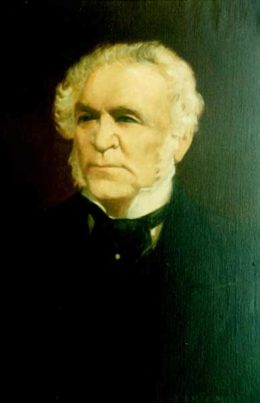
This particular story of magic consists of the slightest mention of legerdemain performances. Still, the early date of the events gives it some importance and interest. As well, the subject of this tale went on to become a highly regarded leader in New Zealand; he is probably the only magician to have had a town named after him.
We will not venture on a full biography of Joseph Masters, since there are plenty of online histories, concerning mainly his life in New Zealand from 1841. (1) An assembled collection of his own memoirs, and additional information, was published in 2005 as “The Memoirs of Joseph Masters: Founder of Small Farm Settlements for the 'small Man'”. However, Masters’ life in Australia is generally skipped over in a few sentences, and this information concerning his foray into inn-keeping and entertainment seems to have been largely ignored.
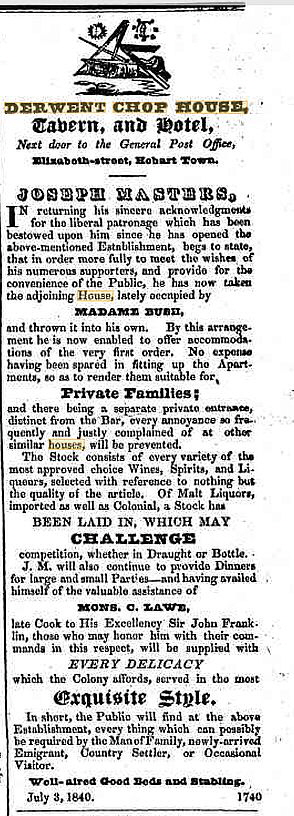
On September 10, 1839, the Colonial Times (Hobart, Van Diemen's Land / Tasmania) mentioned one Joseph Masters as a new applicant for a licence to conduct an eating establishment, the Derwent Chop House in Elizabeth Street, next to the General Post Office. This area serviced local residents and travellers on the road northward; by the 1850s there were eighteen public houses on Elizabeth Street.
Masters had arrived as a free settler (2) in Australia on May 4, 1832 aboard the ship “Mary”, bound for Van Diemens Land with his wife (unnamed in the records, but she was Sarah nee Bourton, 28 years of age) and a four-year-old daughter, Sarah. He was born in Derby in 1802, and apprenticed as a cooper, which trade he used during his early years in Tasmania, working for a whaling firm. In 1834 he was also appointed as an under-gaoler at Hobart Town (3).
Masters and his wife endured a serious scandal in 1835, when Sarah was tried on the charge of infanticide, having allegedly given birth to a child (to a non-European father) while Joseph was away on work duties, and that she had killed the child. (4). Ultimately she was acquitted for want of evidence, but it must have been a fraught time for all involved. Sarah remained with her husband, and lived until 1859.
The Colonial Times of December 24, 1839, announced that “Mr. Masters, of the Derwent Hotel, has prepared a number of very curious puppets, which he purposes to exhibit on Saturday next…”
The press noted that Joseph Masters was a newcomer to the inn-keeping business, but predicted success. Masters, besides providing drinks, meals and accommodation to his clients, was also keen to boost community spirit in a colony where, as the Colonial Times expressed it, “envy is so prevalent, and ill-will too abundant”. In association with Mr J. Hefford of the Waterman’s Arms, and Mr. Lovick of the Angel Inn, a joint gathering on the weekend after Christmas 1839 was organised, featuring games and other entertainments of the kind featured in fairs of England, and notably an exhibition of “Fantoccini” or puppets.
Following this, Mr. Masters continued to exhibit his puppets, presumably at the Derwent Chop House, though this is not stated in advertisements until a later date. The appearance is that Mr. Masters was also the performer.
Colonial Times Hobart Dec 31, 1839 – Fantoccini -
We have paid a visit to Mr. Masters' puppet exhibition, and, really, we were very much delighted. Our young friends will see , in miniature, some very clever tight rope dancing/the comic antics of a humorous clown, some nimble and surprising sleight-of hand, with a variety of other entertainments, particularly applicable to the Christmas holidays. We can safely recommend a visit ; and, we may observe, that Mr. Masters will exhibit to select parties, on any evening that may be appointed.
The very brief mention of “sleight of hand” is supplemented a few months later, when the Hobart Town Courier (March 13, 1840) announced:
Mr. Masters’ Fantoccini
Will re-open on Saturday evening next, with the addition of a PANORAMA and LEGERDEMAIN, and will be continued every evening during the Race week. Commencing at 7 o’clock.
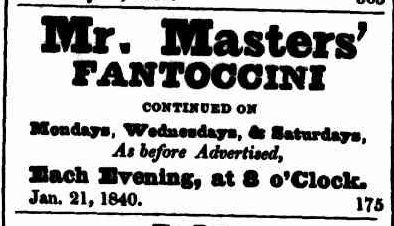
Since the performance of Legerdemain is so slight, we do not consider that Masters qualifies sufficiently to take the title of the second professional magician in Australia; preferring to give that honour to John Powell Courtier in 1841. However it is clear that some amount of magic was being presented.
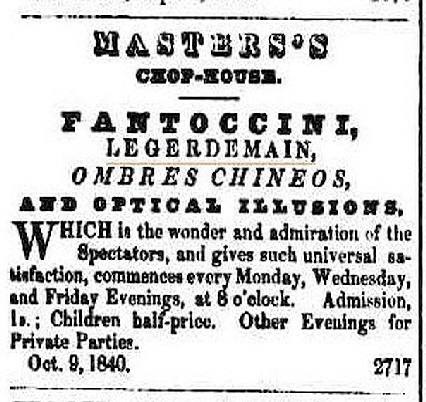
Though not continuous in performance, Masters held seasons of entertainments at the Chop House; from September 2 his “Evening Amusements” ran on Monday, Wednesday and Friday, consisting of “Fantoccini and a variety of other entertainments.” In early October to early November, the billing included Fantoccini, Legerdemain, Optical Illusions and ‘Ombres Chineos’ or hand shadows. Also advertised is a ‘Double Argoscopia which has never yet been exhibited before the public. We must assume this was a form of Magic Lantern, although the only other use of this word was by the other Tasmanian conjuror, Powell Courtier.
Aside from a letter (October 13) to the Colonial Times in which the writer requested that Masters change his performance times “so as not to come into contact with the interests of the Theatre”, the puppets and amusements seem to have been popular, and should have attracted extra clientele to Masters’ establishment.
Mr. Masters exhibited again following the Regatta week, and on November 26, 1840, announced, via the Launceston Advertiser, his intention of visiting Launceston in the north of Tasmania for a month, exhibiting during the Launceston Regatta and agricultural shows. This he did, with success, returning to Hobart around January 1841 after thanking the people of Launceston for their liberal hospitality.
Almost immediately, it seems, disaster struck Mr. Masters’ main business, the Derwent Chop House. Whether Masters had taken his eye off the main game in pursuit of his theatrical interests is not clear, but The Courier of March 12, 1841 announced that the business had gone into insolvency, and William Mortyn was appointed as provisional assignee of the estate and effects of Joseph Masters. A creditors meeting was held on April 10 under the new assignee, Andrew Crombie. In the following year (5), the Derwent’s licence to retail wines and spirits was transferred formally to a George Madden.
It seems that Masters may have gone back into business elsewhere, as in November 1841 he was fined for having "the door of his licensed house open at an unauthorised hour." (6)
Although recorded in the 1842 census as still a resident of 4 & 5 Elizabeth Street (2), Mr. Masters, with his fantoccini, shadows, optical illusions and legerdemain, had left for Sydney in 1841, and shortly afterwards arrived in Wellington, New Zealand. In 1843 the New Zealand Gazette makes mention of a Wellington performance of Punch and Judy, Fantoccini, and optical illusions from the ‘Grand Argoscobia [sic]’. Although Masters is not mentioned by name, it seems reasonable to assume that he was the presenter. (7)
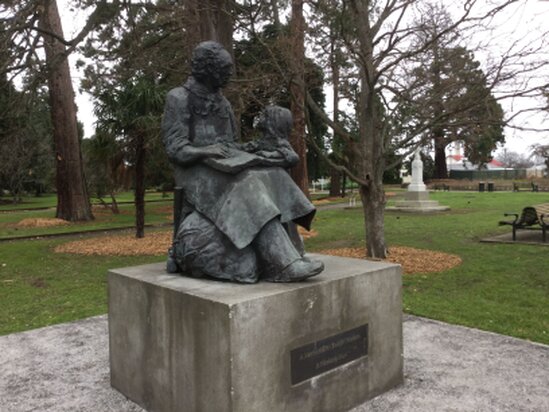
Here, his real calling came to the fore and he became active in encouraging work men to unite to purchase a large block of land, enabling them to become small-farm settlers. He was at the forefront of planning and establishing Greytown in 1854, followed only months later by the establishment of the town which is named after him – Whakaoriori renamed as Masterton, and declared in 2017 to be New Zealand’s most beautiful city. Notwithstanding a controversy that Maori tribal leader Retimana Te Korou (who gifted the land which became Masterton, and the co-founder of the Small Farms Association) had been overlooked, a monument to Masters has been erected to his memory at Queen Elizabeth Park.
Here, his real calling came to the fore and he became active in encouraging work men to unite to purchase a large block of land, enabling them to become small-farm settlers. He was at the forefront of planning and establishing Greytown in 1854, followed only months later by the establishment of the town which is named after him – Whakaoriori renamed as Masterton, and declared in 2017 to be New Zealand’s most beautiful city. Notwithstanding a controversy that Maori tribal leader Retimana Te Korou (who gifted the land which became Masterton, and the co-founder of the Small Farms Association) had been overlooked, a monument to Masters has been erected to his memory at Queen Elizabeth Park.
REFERENCES:-
Special thanks to puppetry researcher, Chris van der Craats, for pointing out the connection to Master’s life in New Zealand.
(1) Biographies – see
https://bellhotelderby.co.uk/2019/07/23/joseph-masters-from-bell-boy-to-founder/
and Wikipedia entries.
http://www.nzearlyhistory.com/g1/p509.htm
https://bellhotelderby.co.uk/2019/07/23/joseph-masters-from-bell-boy-to-founder/
and Wikipedia entries.
http://www.nzearlyhistory.com/g1/p509.htm
(2)Arrival records and early correspondence at:
(3) The Colonist and Van Diemen’s Land Commercial and Agricultural Advertiser (Hobart) April 15, 1834, p. 2
(4) Colonial Times Tuesday 12 May 1835 – Trial of Mrs. Masters
(5) Colonial Times, Hobart, February 15, 1842 page 4.
(6) Colonial Times, Hobart, November 16, 1841 page 2.
(7) New Zealand Gazette and Wellington Spectator, October 25, 1843.